Data at the boundary
otto consumes data from three outside sources: lab files (hosts.json),
repo settings (.otto/settings.toml), and OTTO_* environment variables.
The rule for all of them is the same: pydantic at the boundary, plain
objects inside. External data is validated exactly once, by a spec model in
otto.models, and what crosses into the rest of the codebase is an ordinary
runtime object that is never re-validated.
The spec → runtime pattern
Each kind of input has a *Spec model whose job ends at construction:
hosts.json entry      → HostSpec.model_validate(...)  → spec.to_host(cls, ...)   → UnixHost
settings.toml tables  → settings spec models          → spec.to_runtime()        → backend objects
OTTO_* environment    → OttoEnvSettings               → typed fields (paths, …)
The split keeps validation errors where the data is (a bad hosts.json
field fails with a pydantic error naming the file and field, not a traceback
deep in connection code) and keeps runtime classes free of parsing concerns.
Field names are snake_case end to end — JSON, TOML, models, and runtime
attributes all agree, so there is no translation layer.
One deliberate escape hatch: keys beginning with _ are stripped from each
hosts.json entry before validation — the sanctioned way to keep comments
in a format that has none ("_comment": "…"). Everything else unknown is
still rejected loudly.
Host construction
HostSpec is the abstract boundary model for one
lab-data host entry; UnixHostSpec and EmbeddedHostSpec extend it with
family-specific fields (menus like valid_transfers, embedded strategy
selectors like filesystem and binary_loader, per-protocol option tables
like ssh_options):
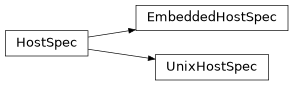
Construction, driven by
otto.storage.create_host_from_dict(), runs in a fixed order:
The entry’s
os_typeselects anOsProfile, which names the base family — and thereby the host class and which spec validates the entry.Profile defaults are merged under the host’s own fields (explicit lab data always wins over profile defaults), and preference-resolved option defaults are folded in (The host subsystem).
The spec validates the merged dict;
to_host()builds the runtime host.Product providers run, attaching products (The host subsystem).
A drift guard in otto’s test suite enforces that runtime host fields and spec fields stay mirrored — adding an init field to a host class without its spec counterpart fails CI.
Settings and environment
OttoEnvSettings (pydantic-settings) is the single reader of OTTO_*
variables. Repo settings.toml files are parsed during bootstrap phase 1
into Repo objects (The command lifecycle); their tables ([docker],
[reservations], [coverage], [[os_profiles]], [host_preferences]) each
have spec models. otto.models.settings is deliberately a leaf module — it
must not import the packages it configures, or validation would drag the app
graph into every boundary crossing.
Where labs come from: the storage package
Lab loading is behind a protocol so hosts don’t have to come from JSON files:
LabRepository (in otto.storage.protocol) is the host-source
contract, the built-in json backend reads hosts.json files from the
configured lab paths, and alternatives (a database, an inventory service)
register a name via otto.storage.register_lab_repository().
otto.testing.assert_lab_repository_conforms() verifies a custom backend
against the contract, and otto.examples.lab_repository is a copyable
reference implementation. See Host Database.
Merging is part of loading: --lab may be passed multiple times and the
resulting Lab objects merge, so a shared lab file and a personal overlay
compose without editing either.
Schemas as exports, not just validation
Because every boundary is a pydantic model, otto can emit its data contracts:
otto schema export writes JSON Schemas for hosts.json,
settings.toml, and reservation files, which editors use for completion and
inline validation (Editor schemas (autocomplete for hosts.json & settings.toml)). The schema version is
bumped when host-spec fields change shape, keeping downstream lab data
diagnosable.
Filesystem awareness
One boundary is physical: where otto writes. otto.filesystem detects
network filesystems (NFS/SMB), and write-heavy components adapt — the monitor
database uses SQLite WAL journaling on local disks but DELETE journaling on
network mounts (where WAL’s shared-memory semantics are unreliable), and log
rotation time-boxes its directory scans so an NFS stat storm cannot stall
startup (Logging).